GitHub Actions
Use the public API to trigger source scans from GitHub Actions. The generated API reference documents request and response details, but this workflow is the recommended starting pattern.
The console also provides a generated zeroquarry.yml under
Account > Integrations > Automated Scans. Use that file when you want the
latest maintained template, including API error handling and the optional
polling gate.
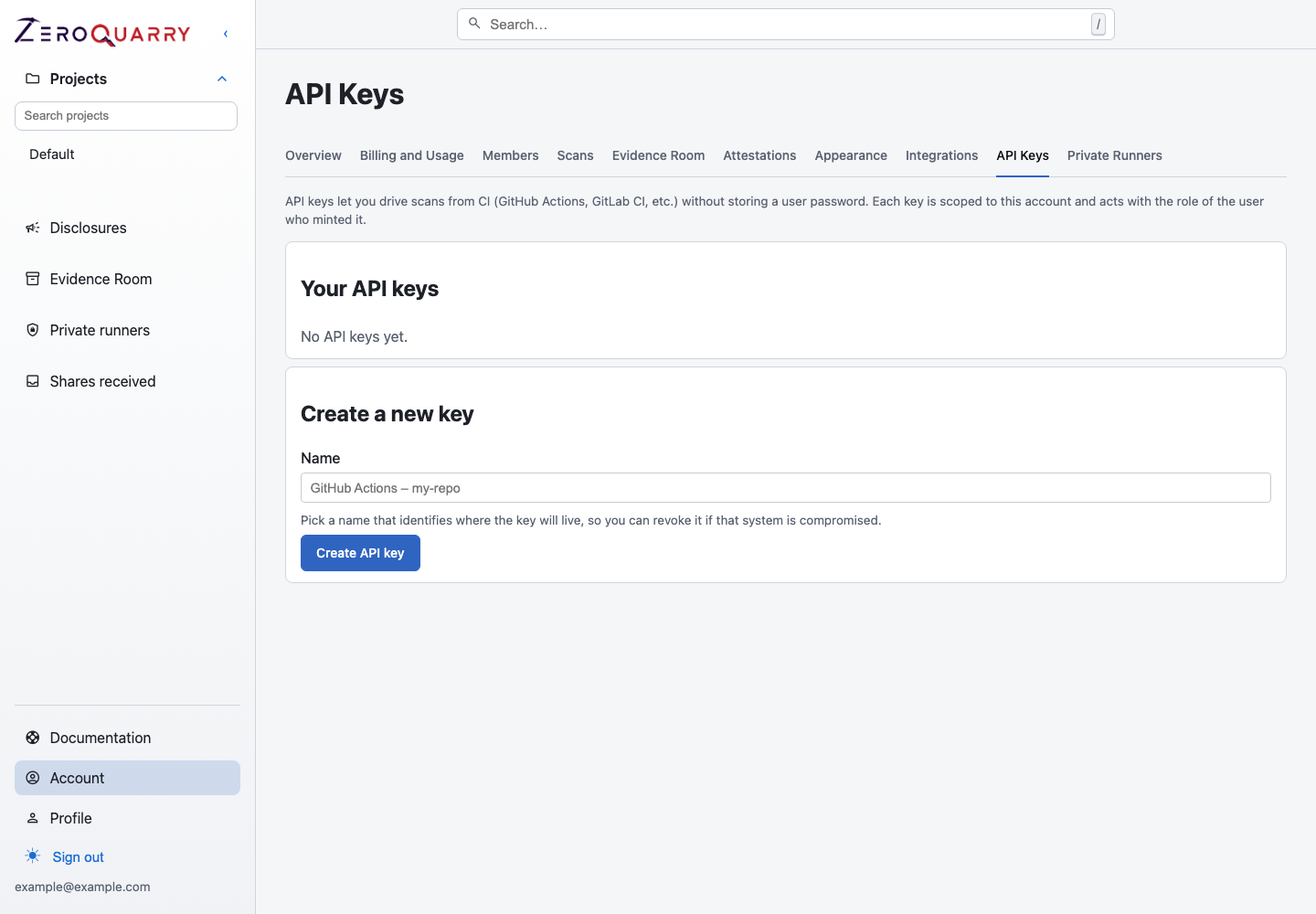
The API key page is the console-side setup step for any GitHub Actions or CI workflow that needs to create scans programmatically.
Create an API key
- Open Account > API Keys in the ZeroQuarry console.
- Create a key for the repository or CI system.
- Copy the key value. It is shown once.
- Add it to the GitHub repository as a secret named
ZEROQUARRY_API_KEY.
Add the workflow
Create .github/workflows/zeroquarry.yml:
name: ZeroQuarry

on:
  push:
    branches: [main]
  pull_request:
    branches: [main]
  workflow_dispatch:

env:
  ZEROQUARRY_API_URL: https://api.zeroquarry.com

jobs:
  scan:
    runs-on: ubuntu-latest
    permissions:
      contents: read
    steps:
      - name: Trigger ZeroQuarry scan
        id: scan
        env:
          ZEROQUARRY_API_KEY: ${{ secrets.ZEROQUARRY_API_KEY }}
          REPO_URL: ${{ github.server_url }}/${{ github.repository }}.git
          REPO_NAME: ${{ github.repository }}
        run: |
          set -euo pipefail

          payload=$(jq -n \
            --arg repo "$REPO_URL" \
            --arg name "$REPO_NAME" \
            '{
              mode: "source",
              git_urls: [$repo],
              project_name: $name,
              auto_delta: true,
              name: $name
            }')

          response=$(curl -fsSL \
            -X POST "$ZEROQUARRY_API_URL/v1/scans" \
            -H "Authorization: Bearer $ZEROQUARRY_API_KEY" \
            -H "Content-Type: application/json" \
            -d "$payload")

          scan_id=$(echo "$response" | jq -r .id)
          dispatch=$(echo "$response" | jq -r .dispatch)
          echo "Scan $scan_id dispatched ($dispatch)"
          echo "scan_id=$scan_id" >> "$GITHUB_OUTPUT"
The first matching Git target creates a full baseline. Later requests with
auto_delta: true can dispatch a changed-code scan. If the same Git scan is
already running, the API can return the existing scan with dispatch: dedup;
treat it as a successful trigger and follow the returned ID.
Optional gate on high severity findings
Add a polling step if you want the workflow to fail when the completed scan has critical or high findings:
      - name: Wait for findings
        env:
          ZEROQUARRY_API_KEY: ${{ secrets.ZEROQUARRY_API_KEY }}
          SCAN_ID: ${{ steps.scan.outputs.scan_id }}
        run: |
          set -euo pipefail

          for _ in $(seq 1 60); do
            status=$(curl -fsSL \
              -H "Authorization: Bearer $ZEROQUARRY_API_KEY" \
              "$ZEROQUARRY_API_URL/v1/scans/$SCAN_ID" | jq -r .status)
            echo "status=$status"
            case "$status" in
              completed|failed|cancelled) break ;;
            esac
            sleep 20
          done

          summary=$(curl -fsSL \
            -H "Authorization: Bearer $ZEROQUARRY_API_KEY" \
            "$ZEROQUARRY_API_URL/v1/scans/$SCAN_ID/findings")

          crit=$(echo "$summary" | jq -r '.severity_counts.critical // 0')
          high=$(echo "$summary" | jq -r '.severity_counts.high // 0')

          if [ "$crit" -gt 0 ] || [ "$high" -gt 0 ]; then
            echo "::error::ZeroQuarry found $crit critical and $high high findings"
            exit 1
          fi
Private repositories
For private repositories, save a Git credential in ZeroQuarry under
Account > Integrations > Git Private Repositories. When the scan request
omits git_credential_id and exactly one saved HTTPS credential covers every
target host, ZeroQuarry attaches it automatically — so the simple payload above
works for private repos too:
{
  "mode": "source",
  "git_urls": ["https://github.com/example/private-repo.git"],
  "auto_delta": true
}
Pass git_credential_id explicitly only when several credentials cover the
same host or the target uses SSH, where an explicit choice is always required.
See Private repositories.
If the workflow runs on every branch, exclude zeroquarry/fix/** before
enabling auto-fix pull requests. This prevents bot-created
fix branches from continuously creating new scans.