Discovery and approval
Scans feed the library. As agents work they record the surfaces they encounter: URLs observed during remote probing, hosts and ports extracted from source, endpoints declared in a spec, and leads pulled out of product documentation.
Each discovered asset keeps its provenance — which asset or scan led to it, how it was found, and when it was last observed. That is what turns a growing list into something you can reason about.
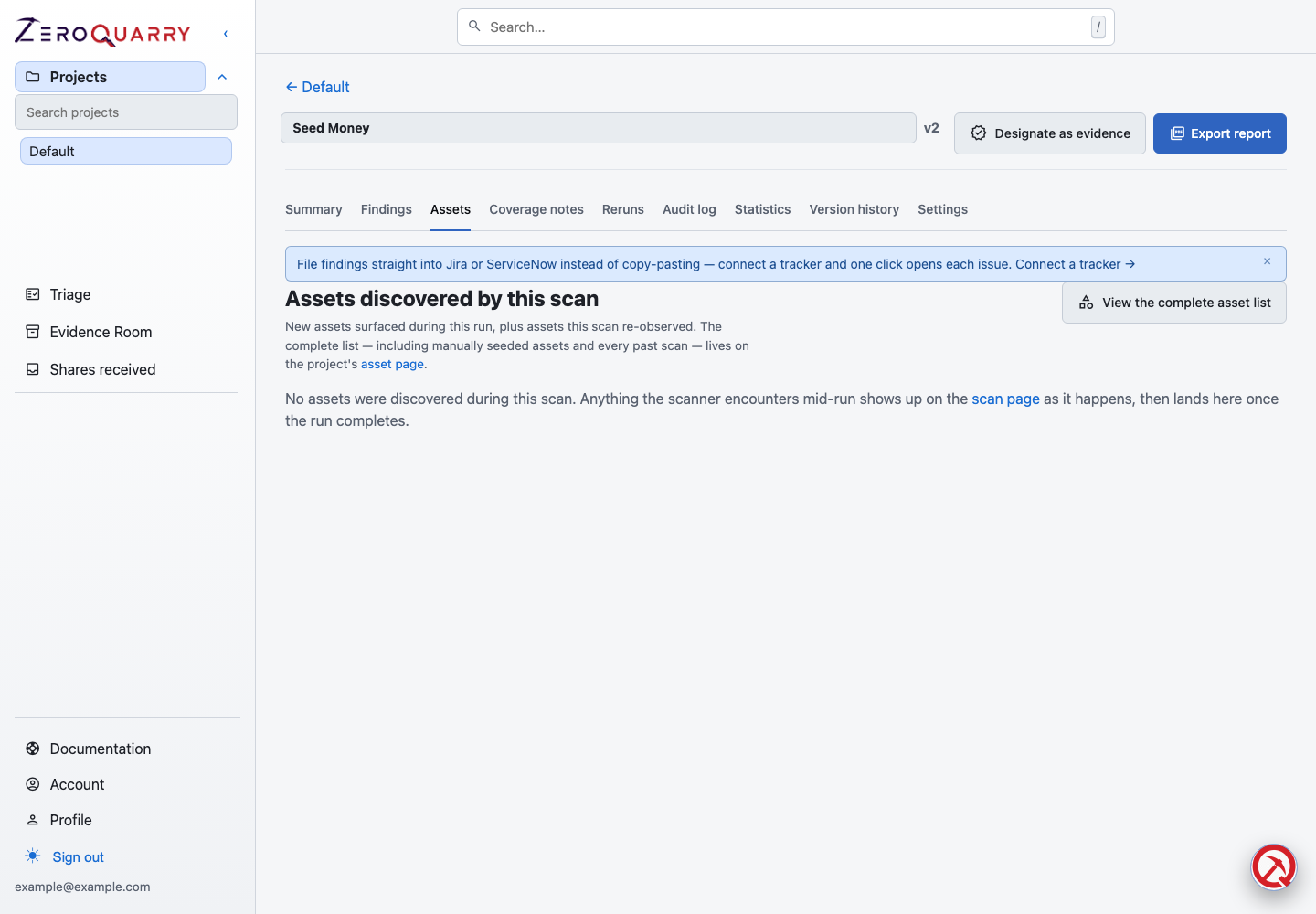
A scan's own Assets tab shows what that scan found. The project's Assets tab is where you decide what to do with it.
The approval gate
Discovered assets start as pending. Pending assets are visible and reviewable but are not scan targets until an owner approves them.
Approval is the gate that turns "something the scanner saw" into "somewhere the scanner may go". It is enforced again at scan launch and during live probing, so an unapproved asset cannot be reached by a running scan either.
Only URL, Host and Repo assets are minted by discovery. A scan that fetches
/openapi.json produces a plain URL asset, and promoting it to a spec source is
a deliberate hop you take yourself — see below.
Identity and deduplication
Two observations of the same thing should not become two rows. The library's dedup key is the canonical form of the asset's target: lowercase host, default port stripped, query dropped.
That key is correct as long as the URL never changes. It does change, though — the bulk host swap, the find-and-replace, the single-asset edit. So the library also tracks aliases and host rewrites, which is what keeps a retargeted asset deduplicated against URLs that scans independently discovered afterwards.
The label chain
Discovered assets mostly come back unnamed, and "Unnamed asset" makes an asset page feel empty even when the library knows a lot about the thing. Labels close that gap, and they resolve in a fixed order:
- Your name. The
namecolumn, never auto-filled. - A generated label. Cached against a content digest of the asset's kind, URL and tech fingerprint, so it regenerates itself when the asset changes.
- A deterministic label. Derived from what the row already knows: template shape, tech fingerprint, document or repo kind.
Labels are display sugar only. Nothing about them feeds gating, scan policy, scan targets, or group membership — a wrong label cannot make something scannable.
Generation is capped per pass, so a scan that discovers four hundred assets labels its newest batch and lets the rest fall back to the deterministic tier.
Grouping into surfaces
Grouping turns hundreds of URL rows into the handful of surfaces an operator actually thinks about. The core primitive is the route template: any URL normalizes to scheme, host, and a template path where opaque segments become parameters.
Two independent mechanisms decide a segment is a parameter:
- Shape. A segment that is a UUID, a long hex string, digits, or a base64-ish blob parameterizes even from a single observation.
- Corpus differential. Sibling segments at the same tree position with two or
more distinct literal values across the project are one variable —
/projects/a,/projects/b,/projects/cbecome/projects/<var>. The observed values ride along on the template, which is how "try other ids" gets into the coordinator's brief as context rather than as a guess.
Guards keep structure structural. Version segments like v1 and v2 never
differential-merge, because they mark real boundaries. Date-like segments are
left alone. And the differential rule never fires at depth one: /api and
/admin are different surfaces, not two instances of one.
Grouping is deterministic. The same corpus in produces the same clusters out, with byte-stable ids. A model may label a cluster afterwards; it never decides what belongs in one.
Specs and documentation as seeds
Two asset kinds turn paperwork into candidates:
- Spec assets accept OpenAPI/Swagger documents, GraphQL schemas or introspection responses, and MCP server definitions. Everything declared in the spec becomes a candidate URL asset linked back to the spec.
- Docs assets accept PDFs, Word files, and documentation repositories. A regex pass and a model pass extract URLs and hosts, and every candidate keeps the provenance of the document that produced it.
Both respect the project's scan policy and blacklist at record time, so an out-of-scope host named in a document cannot widen your boundary.
Promotion
When a scan finds something that looks like a spec or a documentation source, it lands as a plain URL asset. Promotion is the one-click hop to use it as a spec source or docs source instead — the same asset, re-pointed, without re-ingesting the document.
Environment tagging
The same service usually appears several times in a project — console, origin, api, staging, prod — and as peer rows with no way to tell them apart, coverage gaps and briefings all read staging noise as production surface.
Each asset can be tagged prod, staging, dev, or test. ZeroQuarry infers a tag where it can and you can override it, and the source of the tag is recorded so you know which is which.
Next
- The asset graph — what the library learned about how these assets connect.
- Project assets — the short version, if you are still orienting.