Coverage and gaps
Every scan improvises a slightly different walk through a target. Left alone, that means a critical endpoint can sit one directory away from everything the scan touched and never see a single request — not because the model misjudged what to probe, but because nothing made it come back and check.
Coverage is the mechanism that fixes that. It comes from the project's asset library, which knows which routes exist, and the probe ledger, which knows which ones any scan has actually hit. Comparing the two turns an advisory into a contract.
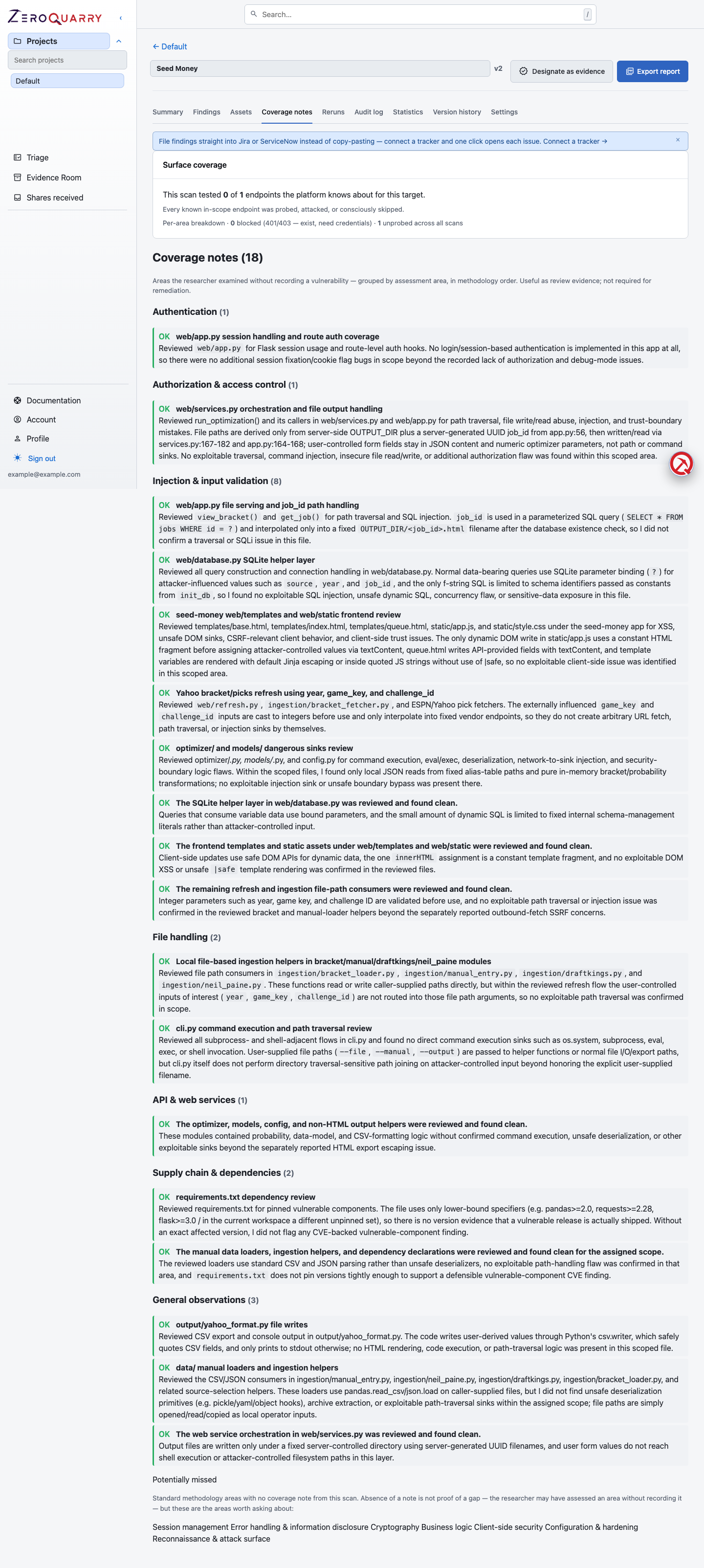
The Coverage notes tab carries the coverage card, the notes grouped by methodology, and the standard areas with no note from this scan.
The wrap-up gate
Near the end of a scan, a note lands in the coordinator's guidance channel telling it that known routes remain. When the coordinator returns, a bounded close-out agent runs: it probes the remaining known in-scope routes, or records an explicit reason for skipping each one.
Whatever is still unprobed and unjustified is logged as coverage debt and surfaced on the report. It does not pass silently.
The close-out pass is budgeted, and that budget is why the ordering matters.
Two gap classes
Never probed — a known in-scope route that no scan of this project has ever probed.
Auth differential — a route this scan answered with its session but never probed without one. An authenticated vantage cannot observe a no-authentication-required vulnerability, because every request it sends carries the cookie. The close-out agent re-probes these routes cookieless.
The class is empty for scans with no configured credentials. There is no differential to close if you never authenticated.
This one is not hypothetical. A known-high unauthenticated bridge was probed repeatedly on a live target, every probe carrying the session cookie, and the miss still looked well-covered.
The gap list is ranked by history
Routes are worked in order of prior-scan evidence:
- Routes that other scans of the same project cited in a finding, weighted by severity and count and annotated with why — "prior scans found SSRF here".
- Auth-differential overlaps.
- Everything else.
An unordered list spends a bounded budget on whichever route happens to sort first. On one target the single route with a rich cross-scan finding history sat at the bottom of an unranked list while the budget went to routes no scan had ever flagged.
How a route answered matters
Coverage distinguishes how a route responded, not merely whether it was contacted.
| Class | Response | Treatment |
|---|---|---|
| Tested | 2xx, 3xx | Counts as probed |
| Blocked | 401, 403 | Exists; leaves the gap list and becomes a "needs credentials" signal |
| Missing | 404, 410 | Probed and absent |
| Error | 5xx, other 4xx | Attempted; the server misbehaved |
Without this distinction a route behind a login looks identical to a route nobody has ever touched. The machinery behind it is described in The asset graph.
Coverage notes
Below the card, the report carries the assessment's own notes — areas examined without recording a vulnerability — grouped by methodology area rather than dumped in one list: authentication, authorization and access control, injection and input validation, file handling, API and web services, supply chain and dependencies, and general observations.
Potentially missed
The tab closes with the standard methodology areas that produced no note from this scan. Absence of a note is not proof of a gap — a researcher may have assessed an area without recording it — but these are the areas worth asking about.
What coverage is not
Read this as evidence about the scan's reach, not as a guarantee that an unprobed area is free of vulnerabilities. A route that was never probed is an unknown, and the honest response to an unknown is to narrow the claim rather than widen it.
Next
- The asset graph — where the known surface comes from.
- Remote target scans — the auth-differential class needs a per-role scan setup to exist.
- Finding lifecycle — for turning what a scan did into a record you can point at later.