External disclosure workflow
Use this workflow when a ZeroQuarry finding may be reported to a vendor, bug bounty program, customer, or coordinated vulnerability disclosure process.
The goal is to turn a scanner finding into a careful, reproducible, policy-aware submission.
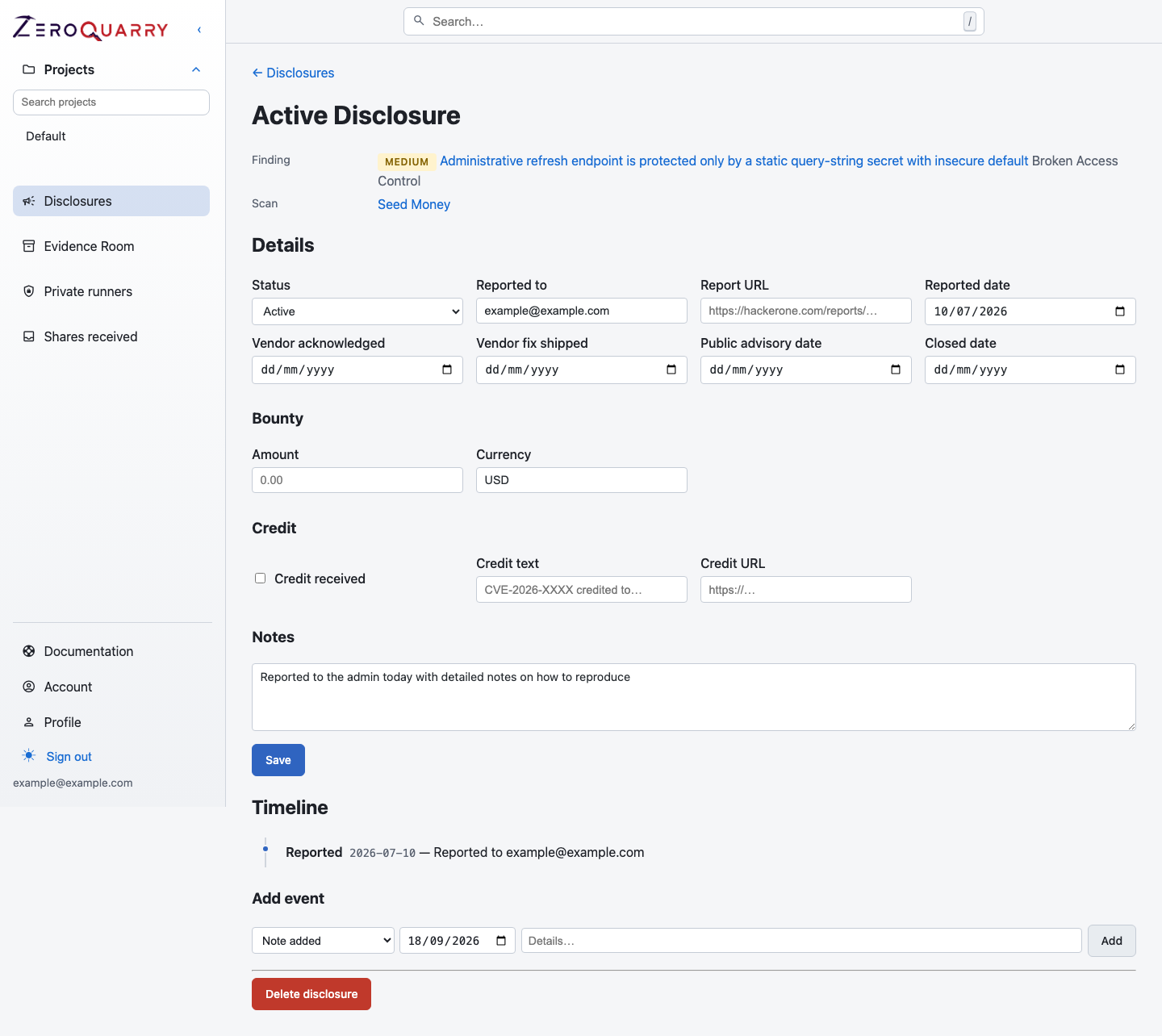
Disclosure records keep the reporting timeline, recipient details, and follow-up history attached to the finding that triggered the submission.
Before you scan
For bug bounty or third-party targets, confirm:
- the target is in scope
- automated testing is allowed
- required researcher headers are configured
- rate limits and destructive-test rules are understood
- credentials are approved for testing
- disclosure timing and public-advisory rules are clear
Remote scans are active tests. If program rules are narrow, start with source or binary evidence you are allowed to analyze, then use remote probing only inside the approved scope.
Read next: Authorization and acceptable use.
Configure the scan for disclosure-quality evidence
Use notes that encode program constraints:
Authorized bug bounty target. Required headers are configured. Keep probes
non-destructive. Focus on IDOR in organization and project routes. Do not test
payment provider callbacks.
For source or binary findings that may become a disclosure, enable:
- independent adversarial review for a skeptical challenge
- HackerOne eligibility review when available and relevant
- artifact generation for exploit proofs and disclosure drafts
Validate the finding
Before reporting externally:
- Read the finding evidence and exploit proof.
- Confirm the target, account, role, and scope.
- Ask finding chat for the minimum reproduction path.
- Check whether the finding falls into a program-ineligible category.
- Remove secrets, unrelated customer data, and excessive payload detail from the external write-up.
HackerOne eligibility labels are review context. They do not replace the program policy.
Create a disclosure record
If your tier includes disclosure tracking, open a disclosure record from the finding or through the API. Record:
- where the issue was reported
- report URL
- reported date
- acknowledgement date
- fix date
- public disclosure date
- bounty or credit details
- notes and timeline events
The tracker is useful even when you report outside HackerOne. It gives your team one place to preserve the history of the issue.
Export the right material
Use an individual finding export when you need a concise submission. Use a full report export when the recipient needs broader assessment context.
Always review generated disclosure emails before sending. Adjust:
- affected product and version
- reproduction steps
- impact language
- remediation advice
- disclosure timeline language
- any program-specific formatting
Read next: Exports and disclosures.
Keep the timeline current
After reporting, add timeline events for acknowledgement, fix, public advisory, credit, bounty, and closure. This helps answer later questions such as:
- Did the vendor acknowledge within policy?
- Which scan found the issue?
- Which evidence was shared?
- Was credit granted?
- Did the issue recur in a later scan?